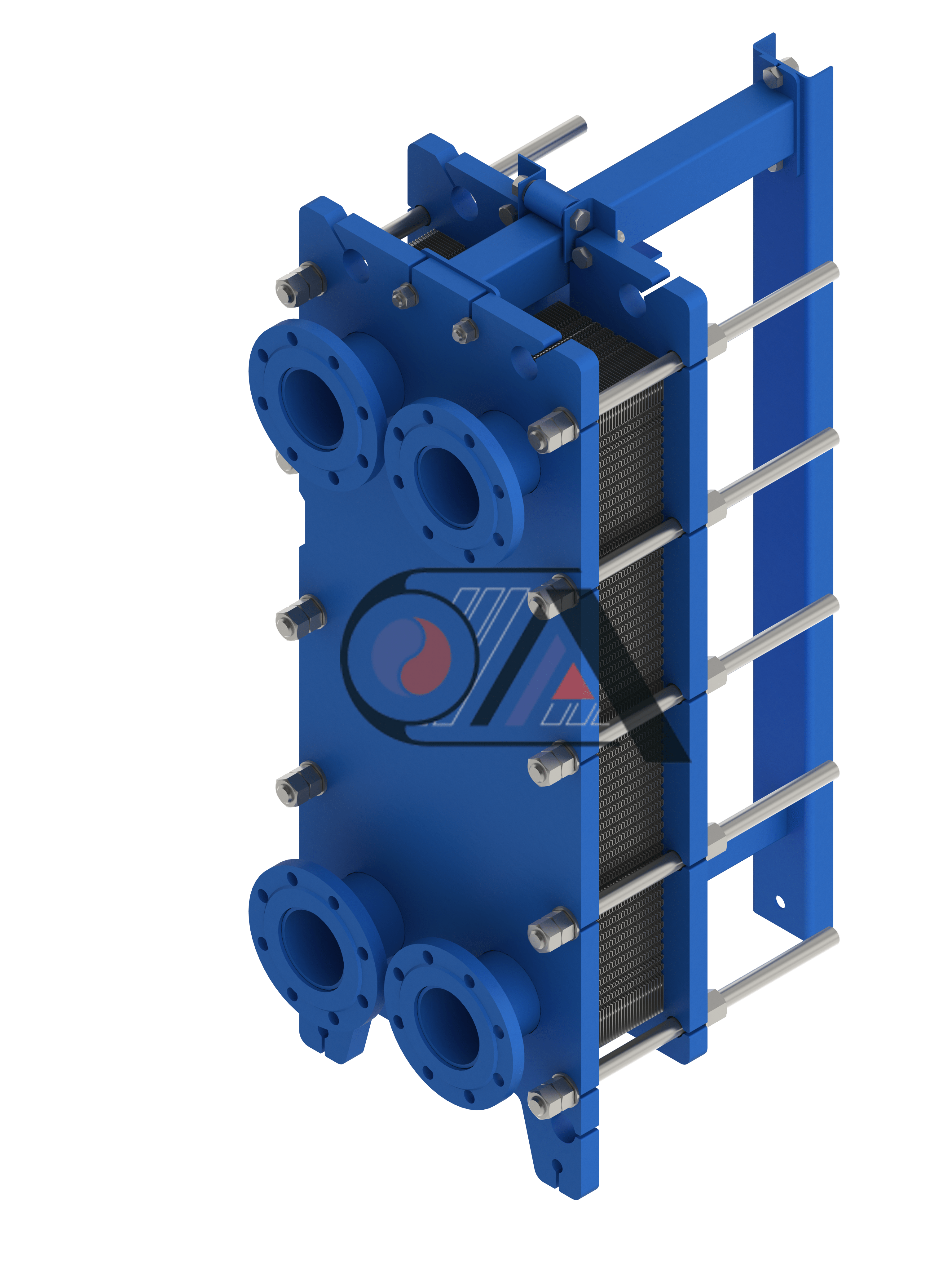
Technical specifications of the criss-cross heat exchanger
Criss-cross heat exchangers manufactured by Ankor-Teploenergo include the main types of the plate ones: classic gasketed, brazed, welded and with removable shell. The corrugations of plates of such products form channels of complex shape, with a varying height along the entire length of the plate. In fact, this complex shape may be called a wave.
The characteristics describing the criss-cross plates of the heat exchanger include the following indicators: angle of the corrugation inclination, channel height and the method of channel formation.
Different angle of the corrugation inclination is typical for the gasketed devices. Options are possible with the use of plates with corrugation angle from 30° to 120°. This indicator affects the heat transfer efficiency and head suppression. If the angle is 30°, the losses will be minimal, but at the same time, the efficiency will also be minimal. As the angle increases, the pressure loss will increase, but the efficiency will also increase.
In conventional devices, a channel is formed of two plates. In other words, in fact, the height of channel is the height of corrugation of the two plates together. This value can vary in all types of criss-cross heat exchangers. It mainly affects the flow rate and, as a consequence, the heat transfer rate and pressure loss. The lower the height, the greater the speed, the more efficient the plate. However, head losses due to this will increase. On the other hand, the higher the corrugation, the more slowly flows the stream. This means that the pressure drop will be lower.
There are essentially three methods of formation: using gaskets, brazing alloy or welding. Gaskets mainly relate to the gasketed units. In the welded heat exchangers, plates are welded together around the perimeter, forming sections. Then they are welded along the collector hole and form a pack. Brazing is used in the manufacture of brazed devices.